The Charge that Changed Things
The Rhino Charge has been running since 1989. It is Kenya's most prestigious off-road fundraising event - held annually in a secret location somewhere in the country's most rugged terrain. Teams navigate between checkpoints across distances that can stretch to 100km of pure bush, rock and riverbed. The vehicle that does it in the fewest kilometres wins. Every team that lines up knows the odds.
In 2025, an electric vehicle built by Silent Savannah entered the event for the first time - the first EV in the history of the Rhino Charge. It was a debut: a statement of intent as much as a competition entry. The team learned the course. The vehicle proved it could handle the terrain.
In 2026, they came back. This time, they finished. The first electric vehicle to complete the Rhino Charge on battery power alone.
This is the story of how that vehicle was built.
Built from the Ground Up
This was not a conversion. It was a ground-up competition build.
The EV Explorers' Rhino Charge car is a custom tube chassis vehicle - fabricated specifically to handle the demands of the event. The chassis is paired with Land Rover Salisbury axles front and rear, chosen for their proven durability in extreme off-road conditions and their compatibility with the torque outputs the electric drivetrain would deliver.
At the heart of the build: a 240kW Lexus electric motor and 120kWh of battery capacity. That combination puts serious power through the axles and gives the vehicle the range to cover a full competition day across demanding terrain - without a single refuel.
"The brief was clear: build an electric vehicle capable of completing one of the hardest off-road events in Africa. We built it."
Engineered for Extreme Conditions
Off-road competition puts very different demands on a drivetrain compared to highway or safari use. Sustained high-torque outputs at low speeds, constant gradient changes, the heat generated by prolonged technical sections, and the mechanical punishment of rough terrain - these are conditions that stress-test every component in a drivetrain.
The 240kW motor and battery management system were configured specifically for the Rhino Charge environment. Thermal management, power delivery curves, and regenerative braking were all calibrated around the reality of a full competition day in Kenyan bush.
Electric motors deliver peak torque from zero rpm. This is not a compromise for off-road use - it is an advantage. The instant torque available from the drivetrain is, in many technical sections, superior to what a combustion engine can produce at low revs. The EV Explorers team found this quickly on the course.
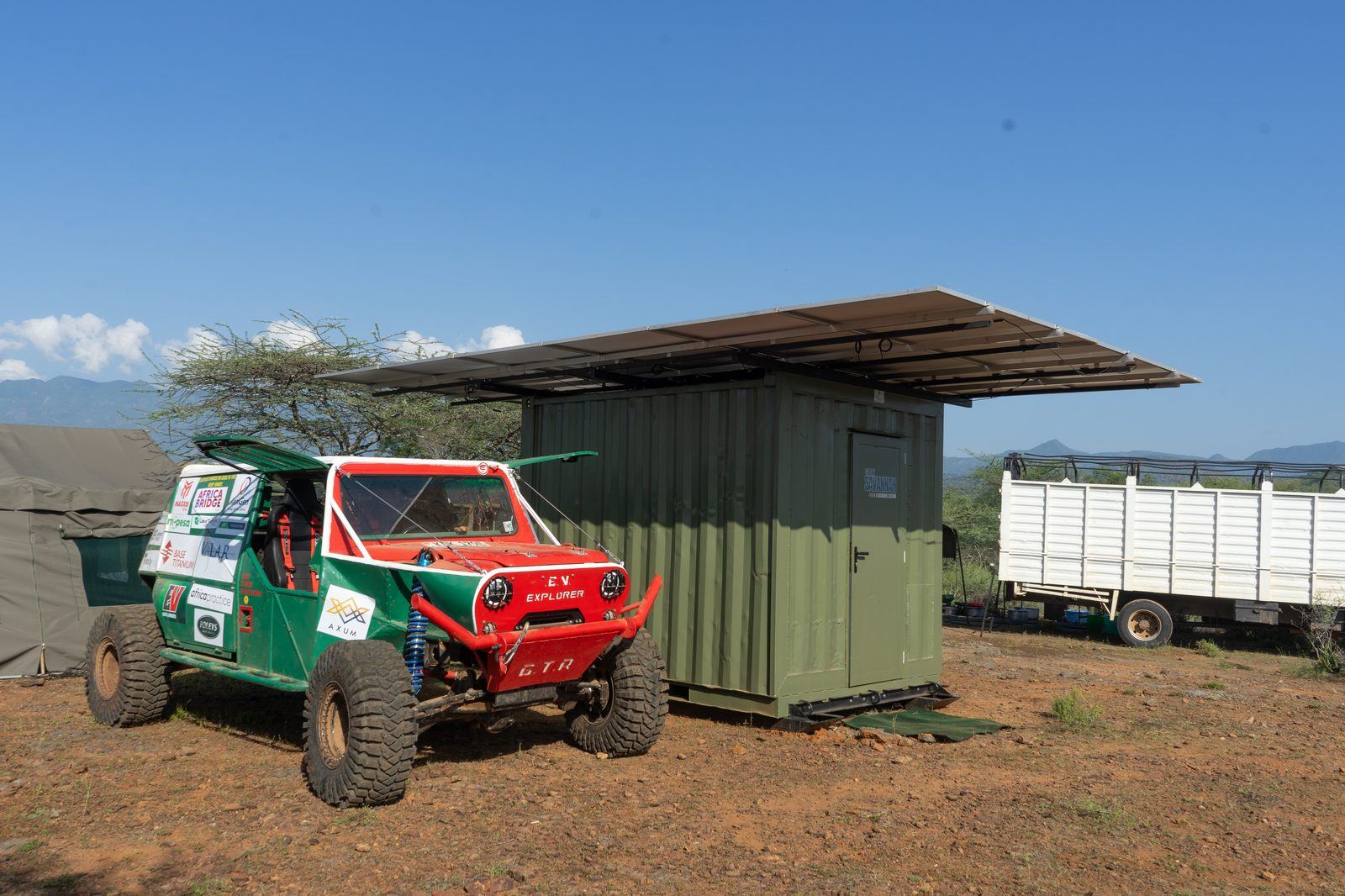
The Silent Savannah solar container at the EV Explorers' base camp, Rhino Charge 2026
Charging in the Wild
The other half of the challenge was energy supply. A diesel vehicle at Rhino Charge carries its fuel. An electric vehicle needs infrastructure. Silent Savannah's answer was the Solar Trailer - a fully off-grid solar charging platform that was deployed at the team's base camp for the duration of the event.
Between competition stages, the vehicle charged directly from the trailer. No generator, no grid connection, no diesel. The solar array replenished the 120kWh battery system steadily through the day, ensuring the car was ready for each section.
It is exactly the model Silent Savannah has designed for safari operations. Vehicle and charging infrastructure deployed together. Completely self-sufficient. No dependency on external energy supply.
What the Result Proved
Finishing the Rhino Charge is significant in itself. It is a gruelling event that eliminates a substantial proportion of the field every year. That the EV Explorers competed in 2025, came back in 2026, and this time finished - on battery power alone - is a statement about the capability of the platform and the team behind it.
It also proved something more specific: that an electric vehicle conversion built for safari use can handle genuine extreme conditions. Rhino Charge terrain is not a laboratory test. It is as close to worst-case as a vehicle will face in the field - and the Silent Savannah build came through it.
The coverage that followed reflected the scale of the achievement. Safaricom's newsroom covered the entry. CIO Africa ran the story. The EV Explorers received attention from across the East African technology and motoring press. For an industry that has long assumed electric vehicles could never work in remote or demanding environments, it landed differently.
What This Means for Safari Operations
The Rhino Charge build is a competition vehicle - purpose-built for one of the hardest events in Africa. Silent Savannah's production conversions (Land Cruiser 79 Series and Land Rover Defender) are road and safari optimised. But the drivetrain technology, the battery architecture, and the solar charging platform are the same across all of them.
The Rhino Charge proved that the underlying system can handle extreme conditions. A game drive is a significantly gentler ask.