A Charging Solution Built for the Bush
Rhino Charge is not a race for the faint-hearted. Each year, teams of drivers navigate up to 100km of Kenya's most unforgiving terrain - dense bush, river crossings, sheer rock faces - in a single day, guided only by GPS coordinates and raw determination. The goal is not speed, but the fewest kilometres covered between checkpoints. It is extreme off-road navigation at its most punishing.
In 2026, the EV Explorers team (supported by Silent Savannah) entered the event in a purpose-built electric vehicle. Behind the ambition sat an obvious question: how do you charge an electric vehicle in the middle of the Kenyan wilderness, with no grid, no generator and no fallback?
The answer was the Silent Savannah Solar Trailer - a purpose-built solution designed specifically for remote areas where solar infrastructure needs to be temorary. Towable, fully self-contained and deployable in under five minutes. Silent Savannah had used a large, less portable solar container to power car 29 at the previous year's event. For 2026, they built something purpose-made: a trailer that could be towed by a standard pickup, and be operational almost immediately on arrival.
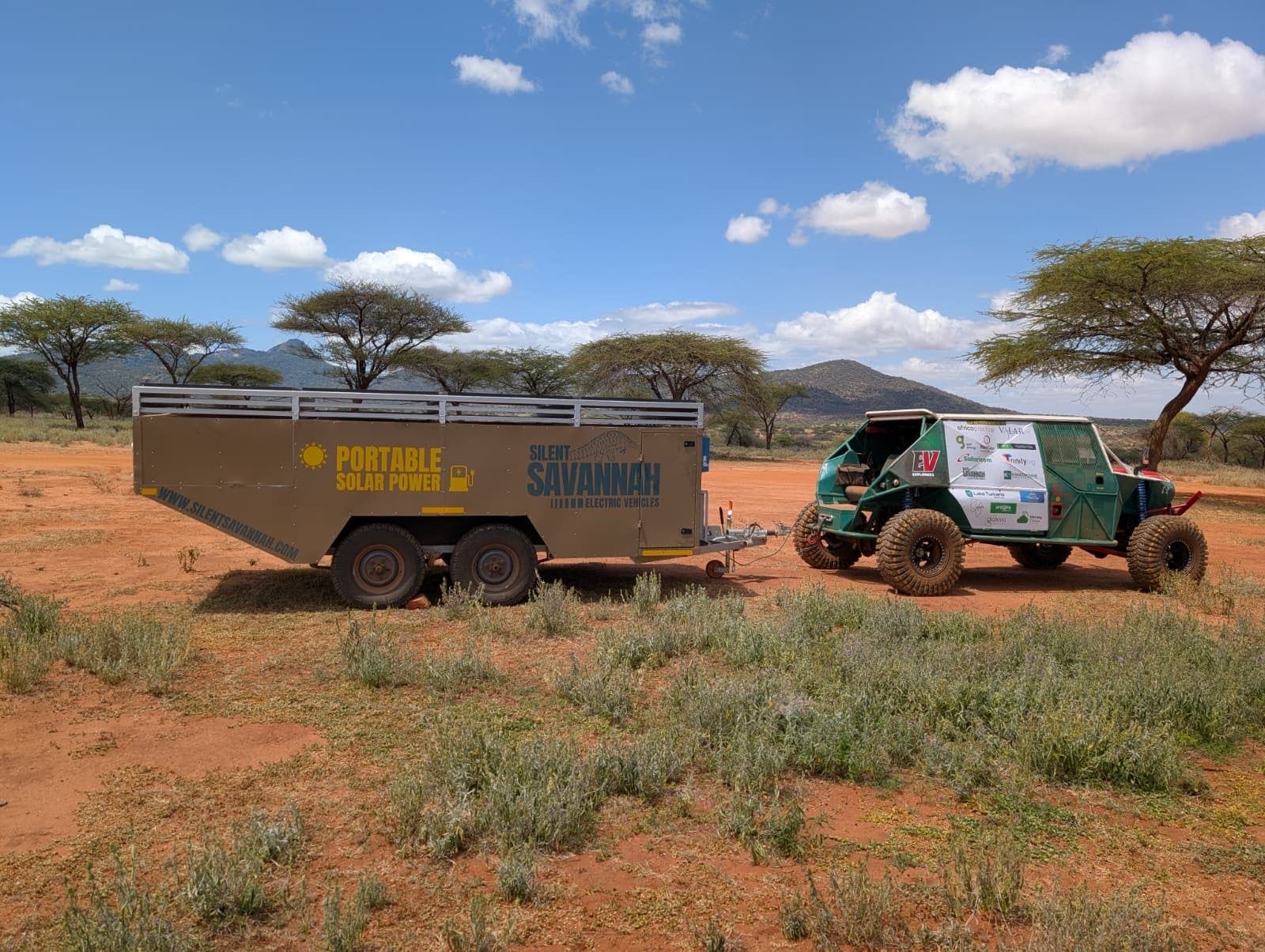
The Silent Savannah solar trailer deployed ahead of Rhino Charge 2026
What the Solar Trailer Is
The Silent Savannah Solar Trailer is a purpose-built, fully off-grid charging platform designed for remote operations. It combines a high-capacity solar array with an integrated battery storage system and EV-compatible charging outputs. All mounted on a rugged, towable trailer that can be deployed anywhere a 4x4 vehicle can reach. Setup time: under five minutes.
No grid connection required. No generator fuel. No compromise.
This is the core principle behind everything Silent Savannah builds. Electric vehicles are only as viable as their charging infrastructure. In the safari industry, lodges operate hours from the nearest town, conservancies span hundreds of square kilometres and fuel supply chains are unreliable. Infrastructure has to be self-sufficient and tough. The Solar Trailer is built around that reality.
"Electric vehicles are only as viable as their charging infrastructure. We built the Solar Trailer to solve that problem completely."
Deployed at Rhino Charge 2026
For the 2026 event, the solar trailer was deployed for the EV Explorers' (Team 29) ahead of competition day. It charged the vehicle to full before the start of the charge, entirely from solar, with no generator and no grid connection.
The EV Explorers then competed on that charge alone. A vehicle charged entirely by the sun, completing one of the most demanding off-road events in Africa.
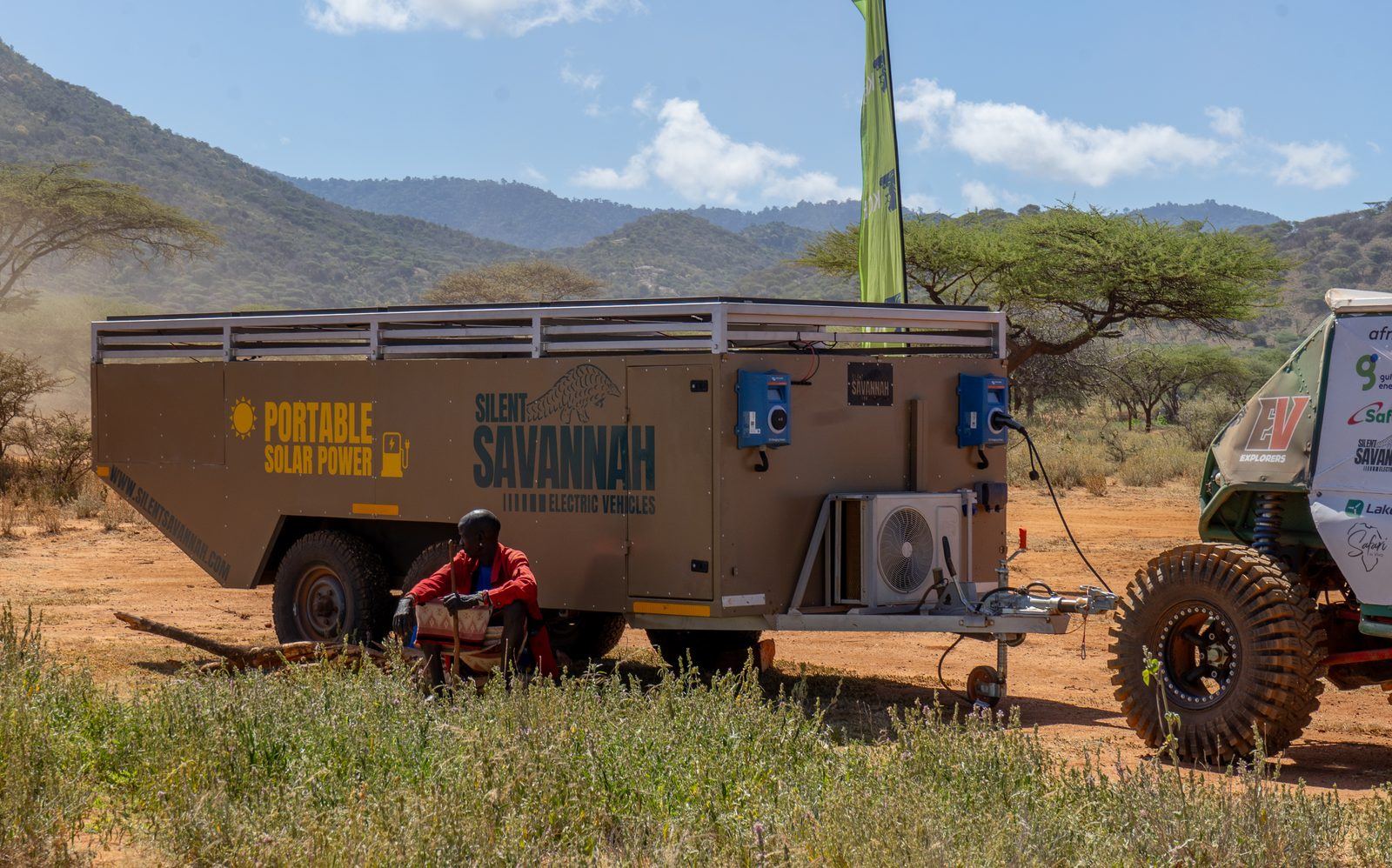
Solar array and charging connections on the Silent Savannah trailer
Why This Matters Beyond the Event
Rhino Charge is a proving ground. The conditions it throws at vehicles and teams (heat, dust, gradient, vibration, distance from any support) mirror exactly what safari operators face in daily operations across East Africa. If a solar trailer and electric vehicle could perform here, it can perform anywhere.
The significance goes further than one event. The safari industry runs on diesel. Lodge fleets, game drives, supply runs - the majority of operational transport in conservancies and national parks is fossil-fuelled and the costs (financial and environmental) are significant. Solar-powered EV charging removes both the fuel cost and the emissions in one step.
Silent Savannah's complete system (electric vehicle conversion plus off-grid solar charging) is designed to make that transition achievable without compromise. The Rhino Charge deployment was proof of concept at its most extreme.
What Comes Next
The solar trailer is available now for lodges, conservancies and expedition operators looking to build out electric charging infrastructure independent of the grid. It can be deployed as a standalone charging station, integrated into a broader solar installation, or kept mobile for operations that move with the seasons.
If you operate remotely and want to understand what a fully electric, solar-powered fleet looks like in practice - we'd like to talk.