The classic Land Rover Defender is one of the most iconic safari vehicles ever built, and thousands are still working hard across Africa. Most of them are still running on ageing diesel engines that are expensive to keep going and noisy on a game drive.
An electric Land Rover conversion gives a Defender a new drivetrain and a new lease of life, without losing its character or its capability. This guide explains how our Defender conversion works, what it costs to run, how far it goes, how it charges and how long it takes.
In this guide
- What is an electric Land Rover conversion?
- Which Land Rovers can be converted?
- What stays and what goes
- Electric Land Rover specifications
- How far can an electric Defender go?
- How is it charged?
- Running costs: electric vs diesel
- How long does the conversion take?
- What is an electric Land Rover used for?
- Warranty and service
- Frequently asked questions
What is an electric Land Rover conversion?
An electric Land Rover conversion removes the Defender's diesel engine, gearbox, fuel tank and exhaust and replaces them with an electric motor, battery pack, inverter and charger. The chassis, body, axles, suspension and transfer box stay in place.
Our conversion is a bolt-in kit. The electric motor mounts to the Defender's original engine mounts and drives directly into the factory transfer box, and the battery pack is fitted low and secure in the vehicle. Because the kit is designed around the Defender, the conversion is clean, repeatable and easy to service.
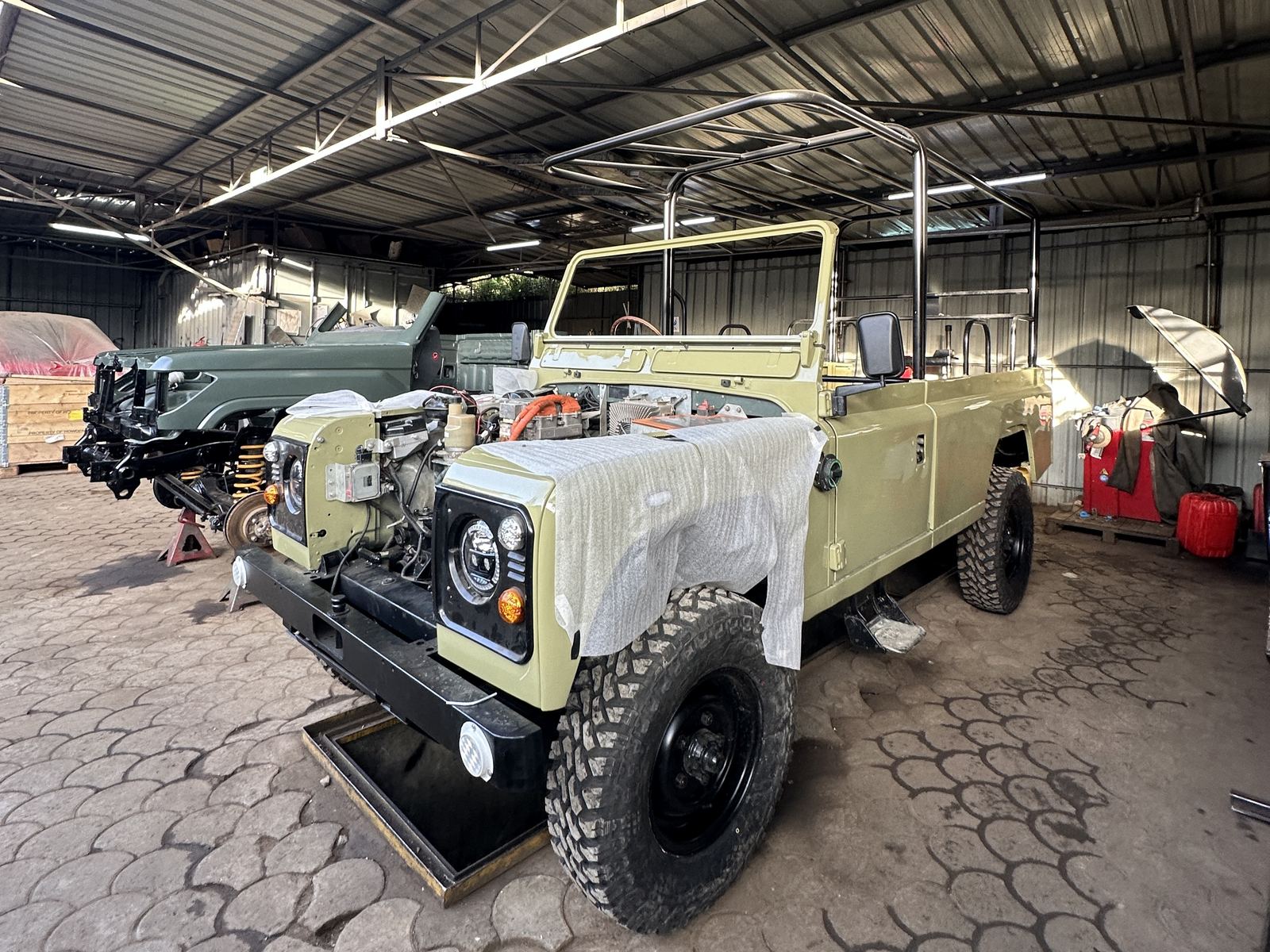
A Defender mid-conversion in our Nairobi workshop
Which Land Rovers can be converted?
We convert the classic Land Rover Defender in both the 110 and 130 wheelbases, across all original engine types. That includes station wagons, pickups and open safari game viewers.
Converting a Defender you already own keeps a trusted vehicle in service and gives it around 10 more years of working life.
What stays and what goes
The Defender conversion is slightly different from our Land Cruiser conversion because the gearbox is removed. The electric motor delivers its power smoothly across the full speed range, so there is no need to change gear.
- Kept: the original transfer box with high and low range 4WD, diff lock, chassis, axles, suspension and body.
- Removed: the diesel engine, gearbox and clutch, fuel tank and fuel system, and exhaust.
- Added: a 160 kW water-cooled electric motor, a 40 kWh or 62 kWh battery pack, a water-cooled inverter and 6.6 kW charger, regenerative braking and custom drive modes.
Electric Land Rover specifications
| Motor power | 160 kW (214 hp), water cooled |
|---|---|
| Torque | 355 Nm, available from a standstill |
| Battery options | 40 kWh (Standard) or 62 kWh (Long Range) |
| Off-road range | Up to 150 km (40 kWh) or 180 km (62 kWh) |
| Charging | 6.6 kW AC on-board charger, inverter and charger water cooled |
| Charging time | Around 6 hours (40 kWh) or 8 hours (62 kWh) |
| Battery lifespan | 10 years |
| Weight added | None on the 40 kWh pack, up to 50 kg on the 62 kWh pack |
| Braking | Regenerative braking |
| Software & data | Custom drive modes, with usage, charging and carbon data |
| Workshop time | Two days |
| Warranty | 40,000 km drivetrain, 2-year battery, driver handover training |
How far can an electric Defender go?
Range depends on the battery you choose. The 40 kWh Standard pack gives up to 150 km off-road, and the 62 kWh Long Range pack gives up to 180 km off-road.
That covers a full day of morning and afternoon game drives with charge to spare for most operations. If your Defenders do longer transfers or patrols, the 62 kWh pack is the better fit.
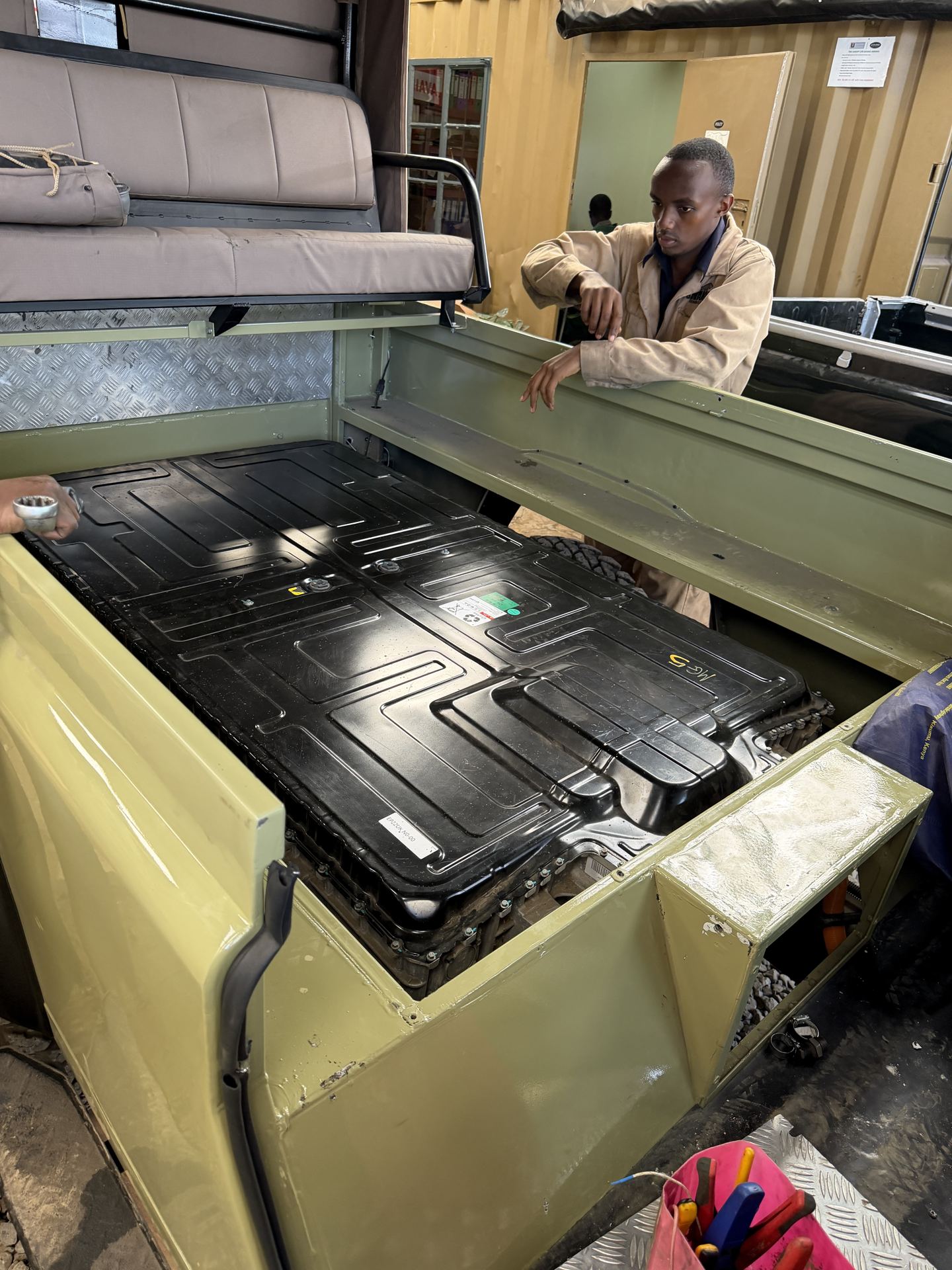
The battery pack being fitted to an electric Defender
How is it charged?
The vehicle has a 6.6 kW AC on-board charger. A full charge takes around 6 hours on the 40 kWh battery or 8 hours on the 62 kWh battery, so it can be charged between drives or overnight.
For camps without a reliable grid connection, our off-grid solar charging containers and towable solar trailers generate and store the power on site. One dual unit can charge up to four vehicles a day entirely from the sun.
Running costs: electric vs diesel
Diesel safari vehicles typically cost around USD 0.40 per km to run once fuel and engine maintenance are included. A solar-charged electric vehicle can run for as little as USD 0.02 per km.
For a typical safari vehicle that works out at over USD 4,000 saved per vehicle per year in fuel and maintenance. An electric drivetrain has no oil changes, no fuel filters, no injectors, no turbo and no exhaust to replace, and regenerative braking reduces wear on brake pads.
To see what your own fleet would save, try our electric safari vehicle running cost calculator, which lets you enter your own distances and costs.
How long does the conversion take?
The conversion takes two days in our Nairobi workshop. Every Defender follows the same five steps:
- Assessment: we inspect the vehicle and confirm the conversion scope and battery choice.
- Strip: the diesel engine, fuel system and exhaust are removed.
- Install: the motor, battery pack and power electronics are fitted.
- Calibrate: software tuning, battery management setup and drive modes.
- Test: field testing on tarmac, bush track and off-road before handover.
What is an electric Land Rover used for?
Any Defender 110 or 130 in your fleet is a candidate, whatever it currently does.
- Game viewers: guests hear the bush instead of the engine, and wildlife is disturbed less.
- Ranger and anti-poaching: a silent approach, no fuel signature and no diesel run to remote posts.
- Research: low disturbance for collaring, darting, census work and camera trap rounds.
- Camp and lodge support: supply runs, laundry, staff movements and maintenance without the fuel bill.
- Guest transfers: a quiet, clean first impression on the drive in from the airstrip.
- Conservancy operations: fence lines, road maintenance, water points and boundary checks.
Warranty and service
Every conversion comes with a 40,000 km drivetrain warranty, a 2-year battery warranty and handover training for your drivers and guides as standard.
For operators who want more cover, we offer annual service packages that include drivetrain inspection visits, battery state-of-health assessments, remote telemetry and emergency callouts, as well as extended battery warranties. Our own team supports vehicles in the field across East Africa.
We also offer cash back on your used diesel drivetrain components, which helps offset the cost of the conversion.
Frequently asked questions
How much power does an electric Land Rover Defender have?+
Our electric Land Rover conversion uses a 160 kW (214 hp) motor producing 355 Nm of torque available instantly from a standstill, with no turbo lag.
Does an electric Defender keep 4WD and low range?+
Yes. The Defender conversion retains the original transfer box, so you keep high and low range 4WD and the diff lock. The gearbox and clutch are removed because the electric motor does not need them.
What is the range of an electric Land Rover Defender?+
Up to 150 km off-road on the 40 kWh Standard battery, or up to 180 km off-road on the 62 kWh Long Range battery.
How long does it take to charge an electric Defender?+
Around 6 hours for the 40 kWh battery and 8 hours for the 62 kWh battery using the 6.6 kW on-board charger, from solar or the grid.
Which Defender models can be converted?+
The classic Land Rover Defender 110 and 130, across all original engine types, including station wagons, pickups and game viewers.
How long does an electric Land Rover conversion take?+
Two days in our workshop in Nairobi, Kenya.
How much does an electric Land Rover conversion cost?+
Pricing depends on the battery option and your vehicle. Send us an enquiry and we will send you a quote, along with details of cash back on your used diesel drivetrain components.